Petrol vs Hybrid vs Electric Cars: Which Holds More Wrecking Value in NZ?
Buying a car today is no longer just about fuel economy or monthly running costs. Kiwi drivers are thinking further ahead than ever before. People now want to know what happens at the end of a car’s life, too.
Will the vehicle still hold value after years of use? Can it still be sold if repairs become too expensive?
And most importantly, which type of car actually gives better wrecking value: petrol, hybrid, or electric?
With the New Zealand vehicle market changing quickly, this is a smart question for car owners. Petrol vehicles are still common on roads, while hybrids and electric vehicles are becoming more popular. Hybrid vehicles are also growing in popularity. However, relatively few blogs discuss a useful topic that is important to regular car drivers, while the majority concentrate on fuel performance and ecological impact:
What happens when the car is no longer worth driving?
That’s where the value of wrecking becomes important.
Whether a car has failed its WOF, suffered accident damage, developed major mechanical issues, or simply reached the end of its life, there’s usually still money left in it. The amount depends on the vehicle type, demand for its parts, and the value of its recyclable components in today’s market.
And surprisingly, the answer is not as straightforward as many people expect.
Why Wrecking Value Matters More Than Ever in NZ
A decade ago, most people only cared about resale value. But today, rising repair costs are changing the way people think about vehicles.
Electronics, sensors, costly parts, and detailed systems abound in modern vehicles. Thousands might easily be spent on a single repair bill. Owners of many vintage cars ultimately reach a point when it is no longer financially feasible to fix the vehicle.
That’s when people start searching for cash for cars in NZ, car wreckers near me, and more. And this is exactly where different vehicle types begin to show major differences in value.
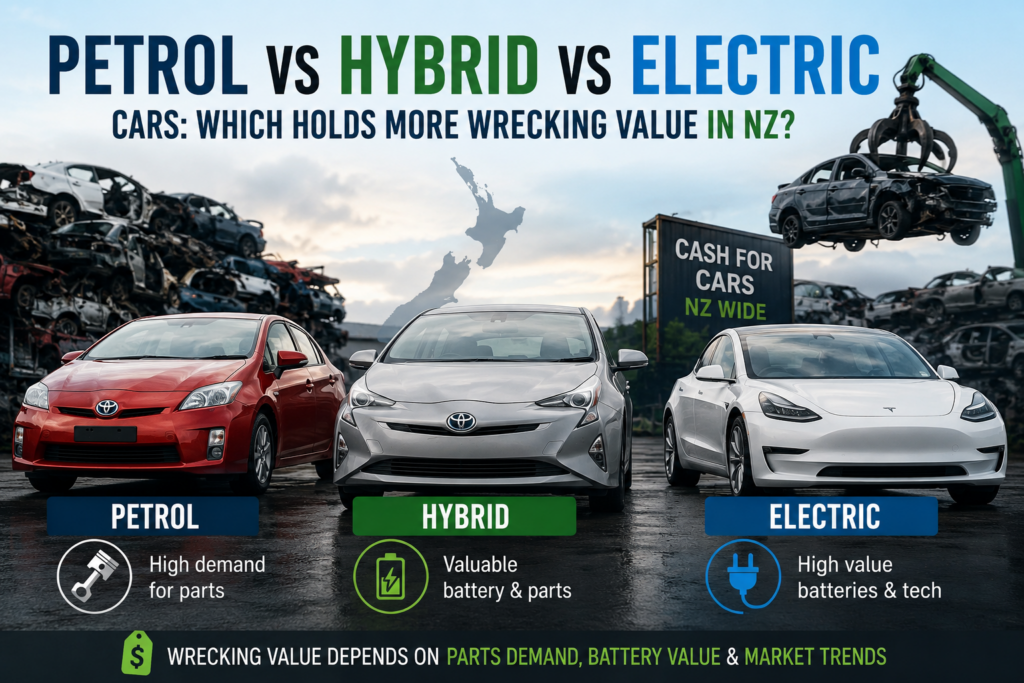
Quick Comparison: Petrol vs Hybrid vs Electric Cars in the Wrecking Industry
Wrecking Value in NZ | Stable and consistent | Very strong overall | Can be high but varies heavily |
Most Valuable Components | Engine, gearbox, catalytic converter, body parts | Battery, inverter, engine parts, hybrid electronics | Battery pack, electric motor, and charging systems |
Demand for Used Parts | Extremely high | Rapidly growing | Still developing in NZ |
Battery Value | None | Moderate to high | Very high if the battery is healthy |
Ease of Dismantling | Easy | Moderate | Complex and specialised |
Recycling Potential | Good metal recycling value | Strong battery recycling potential | High battery material recovery value |
Repair Costs Before Wrecking | Moderate to high | High | Very high in many cases |
Long-Term Market Outlook | Slowly declining | Growing strongly | Expanding but unpredictable |
Best For | Affordable repairs and common parts demand | Best balance of value and efficiency | Future-focused technology |
Common NZ Examples | Toyota Corolla, Mazda Demio, Nissan Tiida | Toyota Prius, Aqua, Corolla Hybrid | Nissan Leaf, Tesla Model 3, BYD Atto 3 |
Overall Wrecking Industry Appeal | Reliable | Currently, one of the strongest | High potential but more complicated |
Petrol Cars Still Dominate the Wrecking Industry
Despite all the talk around electric vehicles, petrol cars still make up the majority of vehicles being wrecked in Hawke’s Bay. Honestly, they still hold strong value in many situations. The reason is simple. Petrol vehicles have an enormous second-hand parts market. There are millions of them on the road, which means there’s constant demand for used engines, gearboxes, radiators, alternators, doors, bumpers, ECUs, wheels, and countless other components.
Popular models like the Toyota Corolla, Mazda Demio, Honda Fit, Nissan Tiida, and Toyota Hilux continue to generate strong demand because replacement parts are always needed. Wreckers know these parts sell quickly, which allows them to provide competitive prices even for older vehicles.
Another reason petrol cars keep their value is that they’re easy to take apart. Most wreckers already have the tools and know-how to handle them, which makes selling used parts easier and keeps costs down. Still, petrol cars meet challenges. Fuel prices are rising, emissions rules are getting tougher, and older petrol cars cost more to keep on the road. Many owners now choose car removal services instead of paying for repairs that cost more than the car is worth.
While petrol vehicles still perform well in the wrecking industry today, their long-term dominance may slowly decline.
Hybrid Cars Are Quietly Becoming Extremely Valuable
Here’s where things get interesting. Many people think hybrids are hard to wreck or costly to process. But hybrids are actually becoming some of the most valuable cars for wreckers. They offer something petrol cars don’t: two separate sources of value.
A hybrid vehicle still contains all the regular parts found in petrol cars, but it also includes high-value hybrid battery systems and electric components. That combination dramatically increases demand.
Cars like the Toyota Prius, Toyota Aqua, Honda Insight, Lexus hybrids, and Corolla Hybrid are now very common in places like Hawke’s Bay, Hastings, Napier, Havelock North, Flaxmere, and Taradale. As these cars get older, the demand for second-hand hybrid parts keeps growing fast.
Wreckers are now seeing strong value in:
- hybrid batteries
- inverter systems
- electric motors
- battery cooling systems
- hybrid ECUs
- charging components
Even damaged hybrids often retain surprisingly good value because many of these parts can still be reused or recycled.
The biggest factor, however, is the battery.
Most people assume an old hybrid battery is worthless once performance drops. That’s not entirely true. Hybrid batteries still contain recyclable materials and reusable modules that hold significant value within the recycling industry. As battery recycling technology improves worldwide, these components are becoming increasingly profitable. This is one reason hybrid wrecking has become such a fast-growing sector in New Zealand.
Hybrids currently occupy a unique position. They offer fuel efficiency for drivers while also holding excellent dismantling and recycling value for wreckers. That balance is making them incredibly attractive in the used-car and wrecking markets alike.
Electric Vehicles Are Changing the Entire Industry
Electric vehicles are completely reshaping how wreckers think about end-of-life cars.
Unlike petrol or hybrid vehicles, EVs rely heavily on battery technology and advanced electronics rather than traditional mechanical systems. That means their wrecking value works very differently.
There’s no engine, exhaust system, catalytic converter, or even a traditional gearbox in many EVs.
Instead, the value sits primarily inside:
- lithium-ion battery packs
- electric drive motors
- charging systems
- onboard electronics
- software-controlled modules
And these components can be extremely expensive.
A healthy EV battery alone can hold significant value because replacement battery systems are costly and demand for reusable EV parts is increasing worldwide. This is why some damaged electric vehicles still receive strong offers from specialist recyclers and dismantlers.
However, EVs also come with major challenges. Battery systems require specialised handling, trained technicians, safety protocols, and proper recycling infrastructure. Not every car wrecker in is equipped to safely process electric vehicles, especially heavily damaged ones.
That creates inconsistency in the value of EV wrecks. A modern EV with an undamaged battery may hold excellent value. But an older EV with battery degradation or accident-related battery damage may become far less attractive to buyers and wreckers alike.

So, Which Type of Car Holds the Best Wrecking Value?
There isn’t one answer for every car, but current trends show a clear pattern.
Petrol vehicles remain reliable in the wrecking industry due to their large parts market and strong demand for used components.
Electric vehicles have significant value, especially newer models with healthy batteries, but their value can fluctuate widely depending on battery condition and the complexity of recycling.
Hybrid vehicles, however, currently offer the best overall balance.
They combine the familiarity and value of reusable parts of petrol cars with the added value of batteries and electric systems that modern recyclers now actively seek. That’s exactly why more NZ wreckers are investing heavily in hybrid dismantling, battery recycling, and hybrid component recovery.
At the moment, hybrids are in the sweet spot between traditional and future vehicle technologies, making them very valuable in the wrecking market.
Final Thoughts
The automotive world is evolving quickly, and the wrecking industry is evolving with it.
Petrol cars still have strong value thanks to their huge second-hand parts market. Electric vehicles are opening up new opportunities for battery recycling and recovering parts. But right now, hybrids are among the most valuable cars for wreckers. They offer both traditional reusable parts and valuable battery technology. That’s why more Kiwi drivers are starting to care about what their cars might be worth at the end of their life.
At HB Car Removal, we help people across Hawke’s Bay get rid of unwanted petrol, hybrid, and electric cars. We offer fair cash based on the true wrecking value. Even if your car isn’t worth fixing, it can still have real value.
FAQs
Do hybrid cars have better wrecking value than petrol cars?
In many cases, yes. Hybrid cars often have higher resale value because they contain both reusable mechanical parts and valuable battery systems.
Are electric car batteries worth money when scrapped?
Yes. EV batteries contain recyclable materials that retain value even after the vehicle is no longer roadworthy.
Why do wreckers pay more for some cars?
Wreckers usually pay more for vehicles with high-demand parts, valuable batteries, strong resale components, or recyclable materials.
Do petrol cars still hold good wrecking value?
Absolutely. Petrol vehicles continue to dominate New Zealand roads, which means there is still strong demand for second-hand petrol car parts.
Can I sell a damaged hybrid or electric vehicle?
Yes. Even non-running or damaged hybrid and electric vehicles can retain value because many parts, batteries, and electronic systems may be reusable or recyclable.